


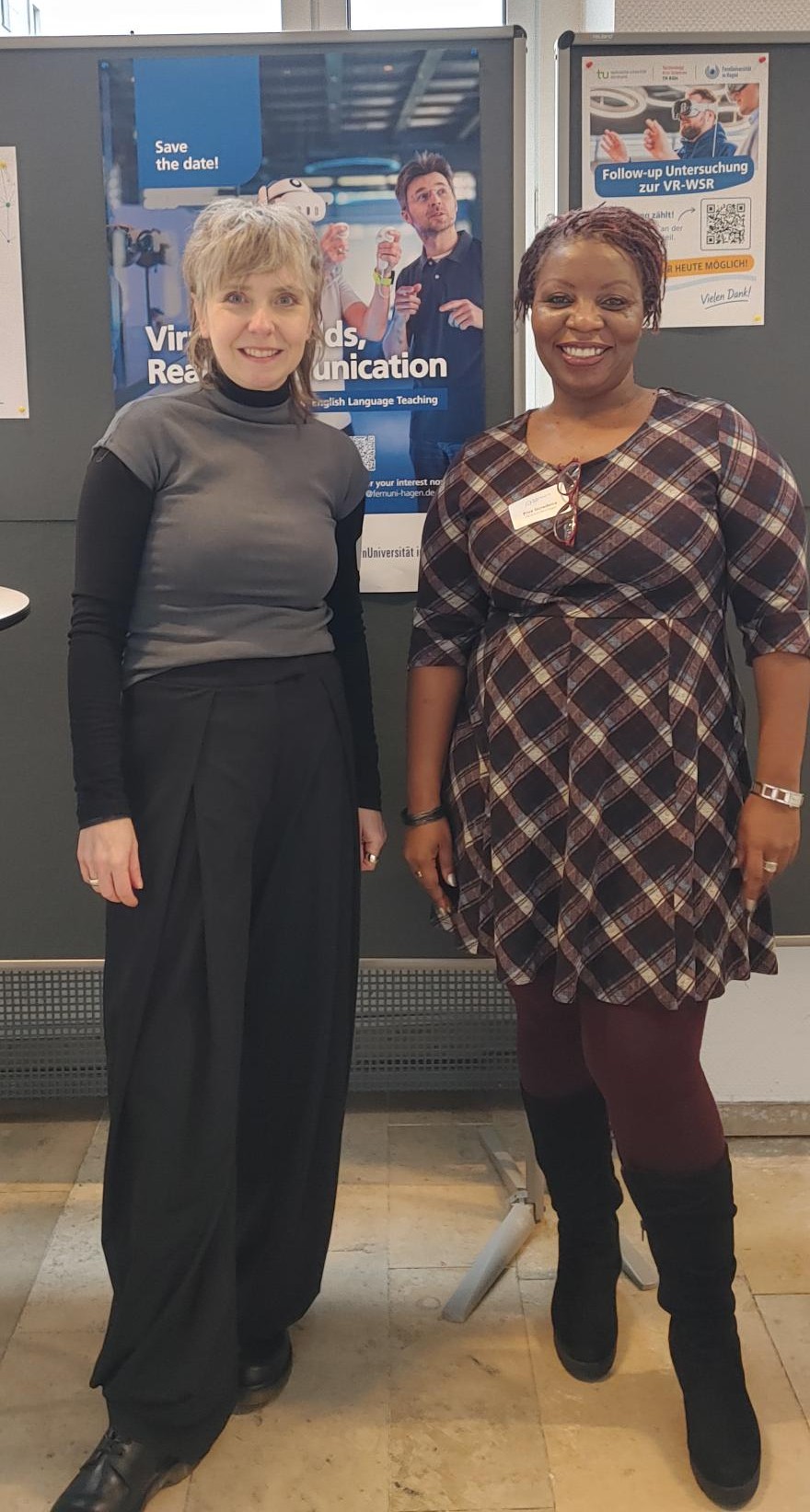
Silke Newig and Dr Prue Goredema were suitably pleased with the day’s proceedings
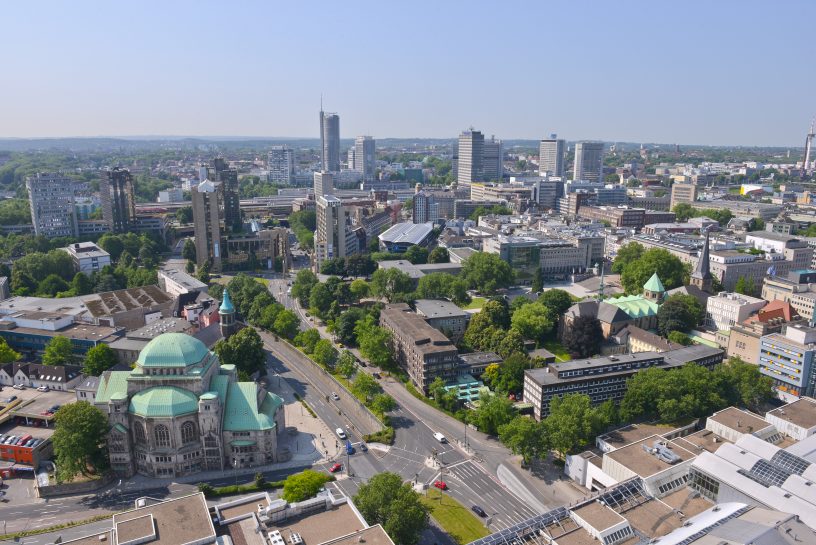
On Friday 20 November, North Rhine-Westphalia’s ed-tech community gathered at the Haus der Technik in the heart of Essen for the Sixth annual Praxistreff, a day of discussion, dialogue and demonstrations pertaining to Virtual Reality and ‘Digital Making Spaces’.
Speakers from the NRW Ministry of School and Education (MSB) opened proceedings, with participants keenly piping up during the plenary Q&A session. We heard how virtual reality is being introduced into schools by some of their more daring peers — slowly and cautiously, with plenty of scrutiny over cost, curriculum alignment and the practicalities of co-option in real classrooms.
A pleasingly diverse programme had been arranged, with the formal sessions complemented by a ‘bar camp’ where nascent ideas and thought experiments were tossed around. Participants then got to pick from various intriguing themes in the parallel sessions, but not before being treated to a delicious lunch, where no palate was left behind. Come to think of it, it would have been deeply embarrassing had the food been anything less than excellent. After all, a city called Essen has a reputation to uphold!
After lunch, it was time for some food for thought.
Ingmar Kempner of the Centres for Practical Teacher Training in North Rhine-Westphalia (ZfsL in Cleves) gave a workshop on Digital Making Spaces where it was standing room only. Whilst game-based learning is hardly new terrain, Kempner brought a fresh perspective and fresh examples of how to harness creativity across the curriculum. Whilst there was a mobile robot illustrating some principle or another on the floor, the attention of most attendees was drawn to a much more hands-on experience, where we got to summon our inner Leonardos in creating various artefacts with the set of 3-D pens Kempner had brought along.
“Games only work in teaching if they are more than a gimmick,” he told participants. “What matters is the combination of mindset, skillset and toolset — knowing why you are using a digital format, having the necessary know-how and choosing the right tools to make the learning outcomes attainable.”
Our own Silke Newig of the Centre for Learning and Innovation (ZLI) also led a workshop on creating VR content with generative AI. “It was a nice atmosphere,” Newig said of her session. “I hope that everybody could take home some new insight or skill so that they are better placed to work with the tool in their own contexts.”
Context is a key concern when it comes to implementing the big promises of VR. Whilst the principles are clearly laid out in books and peer-reviewed journals galore, the reification step is where one might stumble; thus, periodic workshops such as Praxistreff are essential for ed-tech aficionados and personnel from NRW’s media centres — frontline institutions that provide service and support for schools.
Attendee Lena Fuhrmann who is based at a media centre in Lippe said the event was “awfully informative”. “What I found most valuable was the practical angle,” she mused. “You could really see how these ideas might be adapted for different subjects and age groups, rather than just being interesting in theory.”
Dr André Biederbeck and I were all ears, for the various sessions coupled with our informal discussions with other attendees gave us some jolly good ideas for our own teacher workshop, slated for Wednesday 3 March 2027. In conjunction with the British Council, we’ll be hosting a day-long workshop for language teachers, highlighting some use cases for integrating virtual reality in English language classrooms. As places will be limited, prospective attendees are urged to express their interest by clicking on this link.
Leave a Reply