
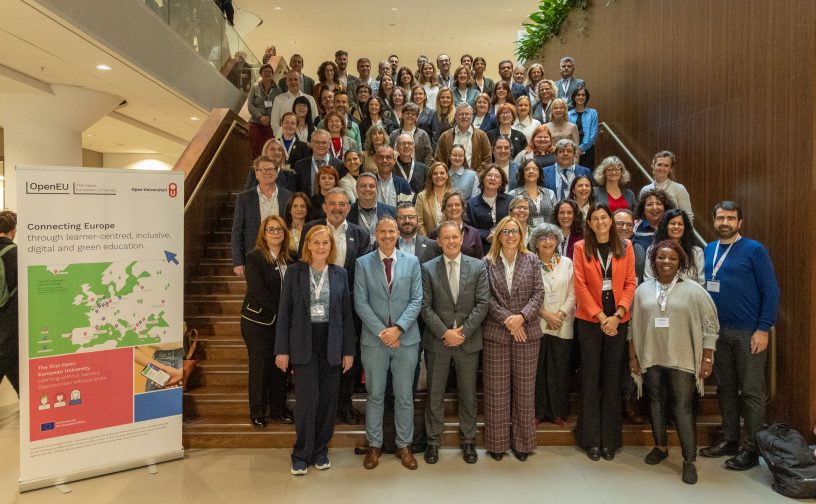


Over three hundred of us — university leaders, lecturers, researchers, policymakers and innovators — were summoned to The Hague!
Don’t worry: the only trial we faced was presenting our work to a stellar crowd at the annual conference of the European Association for Distance Teaching Universities (EADTU) which took place at the Open Universiteit from 28 – 30 October.
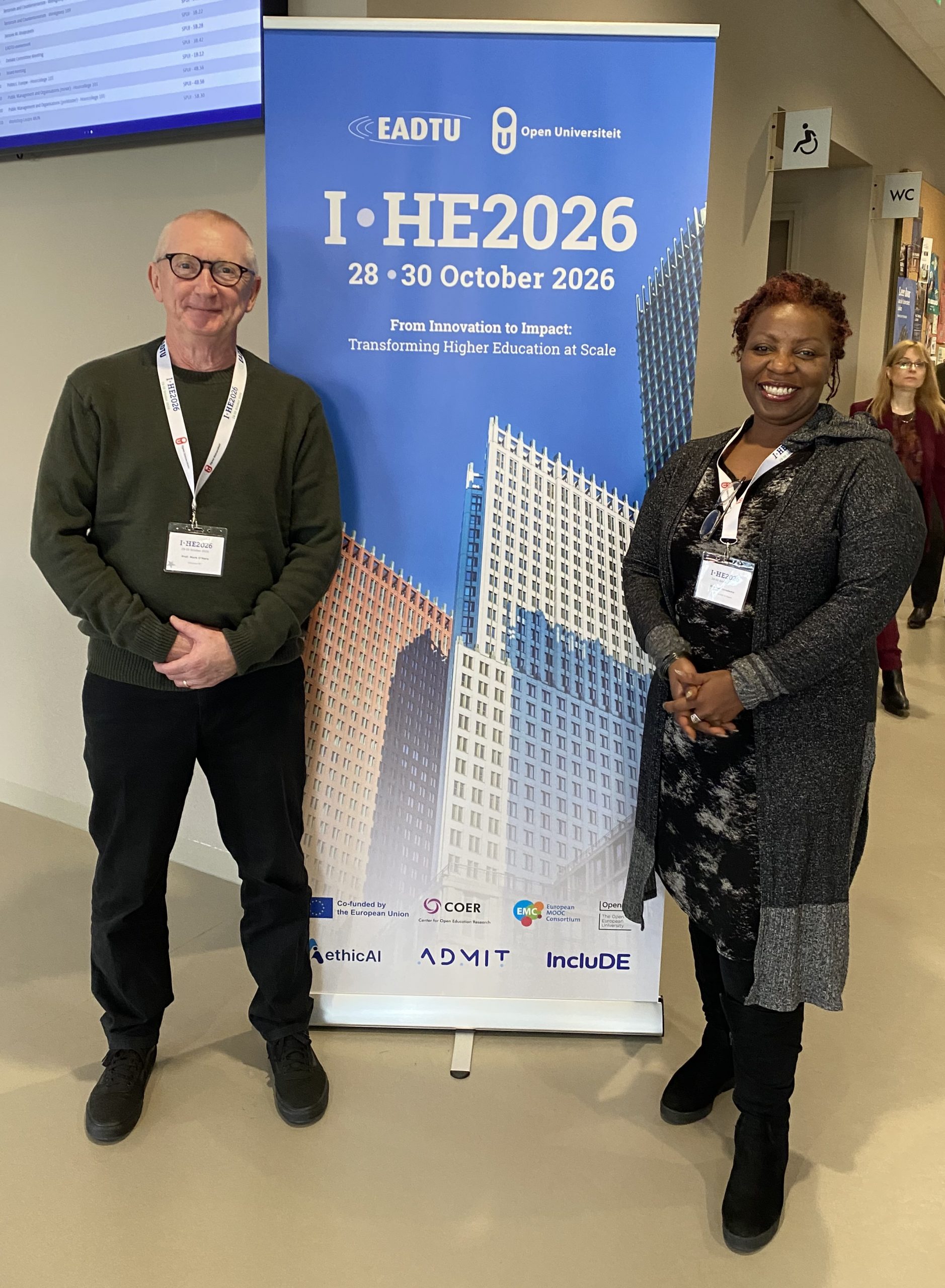
Dutch courage not necessary: Prof Mark O’Hara of Advance HE (UK) and Dr Prue Goredema (studyFIT) had a grand time at the EADTU conference
Opening statements
The 2026 theme “From Innovation to Impact: Transforming Higher Education at Scale” yielded many perspectives that made for memorable keynote plenaries, interactive workshops and thought-provoking presentations.
Prof Theo Bastiaens, outgoing Rector of the Open Universiteit and president of the EADTU, said that the need to confer could not be more pressing. “There is a certain momentum wrought by the AI disruption in our day,” he said. “I would hazard to say that the traditional university is outdated, whereas open and distance universities are already ahead of the pack. These institutions used to cater to second chance learners, but now, lifelong learning, modular instruction and flexible learning pathways are for everyone and are in fact favoured by an increasing number of younger students,” he opined.
In his plenary address, keynote speaker Tom Wambeke of the International Training Centre of the International Labour Organisation (ILO) challenged participants to imagine the future educational paradigms that are just now being signalled by the seeds of change that are scattered about for anyone to see.
As a point of departure for his keynote lecture, Professor David Phoenix, Vice-Chancellor of the Open University posed the question: “If knowledge can be everywhere, what is a university for?”
In a sense, the rest of the conference was a motley mix of researchers and practitioners trying to rise to the challenge of this question, showcasing the many and sundry ways that innovation is at the core of the modern distance and digital university.
A conference charged with good ideas: Evidence enters the record
Exhibit A was a noteworthy presentation delivered by yours truly, entitled “Top of the flops: Lessons from a virtual exchange pilot that veered off course, and the path to scalable redesign.” Far from being a cautionary tale to file away and forget, the presentation drew an enthusiastic response from delegates who are keen to incorporate collaborative formats into their current modules and in future microcredentials.
The session Dr Goredema chaired also had its fair share of feedback, with participants eager to cross-examine the dons in the dock.
Dr Jean Gamester of the Open University briefed attendees in a talk entitled “Once I felt safe, I could focus on taking part”. Co-inquiry to improve collaborative learning with autistic students and educators”, which was met with approval from the bench.
In “Strategies for Intercultural Learning in Online Master’s Programmes: From Academic Tasks to Socio-Educational Praxis” Dr Inés Gillaurena of UNED made the case that intercultural online learning can have a real professional and personal impact, but only if the programme balances rigour, support and practical relevance.
Reporting on a hefty project being undertaken by five universities, Prof Sophie Leontopoulou set out the particulars of the principles and aspirations of their cross-cultural digital wellbeing tool for European universities which has been co-created with students and staff.
Double Dutch: Value Sensitive Design takes the Stand
Skipping to other matters, the OpenEU’s Work Package 5 held a robust Think and Do Tank in which Dr Prue Goredema and Dr Annabell Bils of the FernUni’s ZLI took an active part. In the workshop “Stress-Testing Digital Education Futures through Value-Sensitive Co-Creation” participants deliberated over how the OpenEU’s digital priorities hold up where matters such as efficiency vs equity, personalisation vs privacy and automation vs human agency are in contention. The workshop participants eagerly chimed in without skipping the difficult questions or jumping to conclusions.
Pass the Dutchie: Case for the defence
The good times in The Hague rolled beyond the intellectual discourse within the hallowed halls of the Open Universiteit’s city centre rooms. Rumour has it a raucously happy time was had by a few folks who attended the official conference dinner, with various offences committed against moderation. But even for those of us who had declined to go Dutch and had instead opted for an early night, the conference provided many other opportunities for informal chit-chat, networking and generally keeping abreast of other higher ed news that is seldom shared from the podium.
“There’s real value in the conversations off stage,” quipped FernUni OpenEU Project Manager Sebastian Lauritz, “Oftentimes, that’s where bilateral links are made, common ground is found and new possibilities emerge.”
Prof Mark O’Hara of Advance HE added: “The programme is what brings people with shared interests together, opening opportunities for further conversation.”
The jury has reached a verdict
Conference organiser Stefan Meuleman of the EADTU said he was pleased with the outcome of their cooperation with the Open Universiteit. “What stood out to me was the level of engagement throughout the programme,” he beamed. “People weren’t just attending sessions; they were actively exchanging experiences, challenging ideas and exploring how we can move innovation in higher education from discussion to implementation.” Manon Quint-Fens, an organiser from the Open Universiteit chirped: “It’s been a real pleasure to see everything come together so smoothly. The sessions were strong, the discussions lively, and there was a real sense that people were leaving with ideas they could actually use.”
The final ruling is unanimous: EADTU’s I-HE 2026 conference was a resounding success. Case closed.
Leave a Reply