
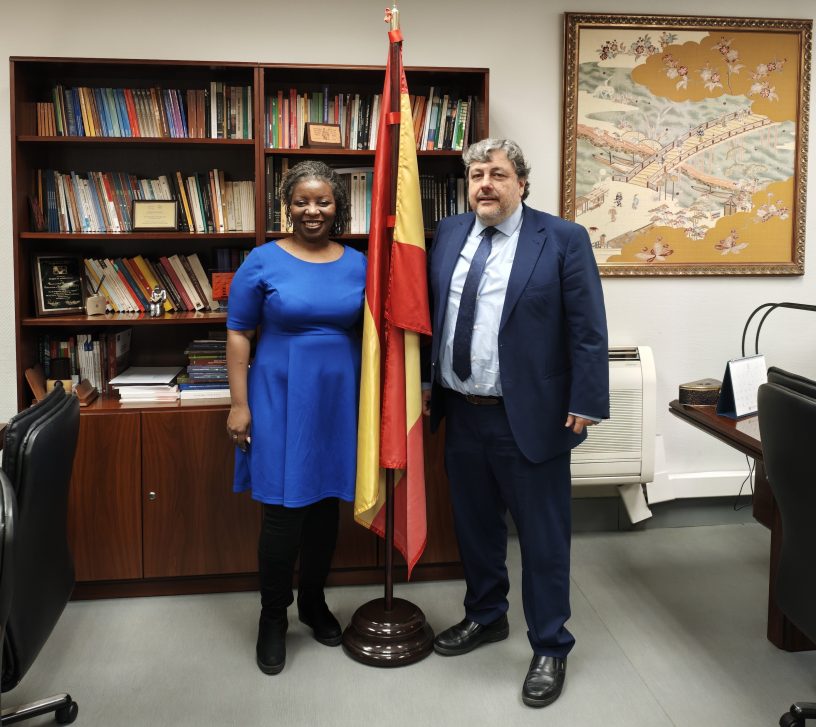



The FernUniversität in Hagen and UNED – The National Distance University of Spain are set to pilot a prospective microcredential on AI for Learning which will be conducted through COIL methodology — Collaborative Online International Learning in summer 2026. The agreement was drawn up during Dr Prue Goredema’s visit to the Madrid headquarters of Spain’s largest university from 26-30 January.
The upcoming Moodle-based studyFIT course is an opportunity for students to learn how to leverage generative AI for their own learning — in multiple disciplines — whilst also improving their language skills in an international setting. It will be a venue to engage in discussion on the manifold ways AI is both delighting and disrupting study, work, governance and society in general.
The visit was conducted under the auspices of the OpenEU Alliance, the €14.4 million pan-European project in development from 2024-2028. One of its key deliverables is a suite of stackable microcredentials — courses recognised across partner universities, enabling learners to build flexible, cross-institutional qualifications.
Recently appointed as a Mission Board Member within the OpenEU research work package, Dr Goredema seized the opportunity to position the studyFIT AI for Learning course as a pioneering step towards that goal.
Nieves Márquez Takahashi of UNED’s Vice-Rectorate for Internationalisation and Multilingualism who served as host at the Madrid tête à tête, said, “We are pleased at this opportunity to deepen our partnership with the FernUniversität in Hagen. Our student bodies have much in common demographically, yet there are also cultural and linguistic factors that would make for wholesome collaboration on a micro-course. The AI for Learning course currently in development will serve as a pilot for a broader model that could eventually be adopted by others across the OpenEU alliance.”
Associate Professor Fernando Val Garijo, UNED Deputy Vice-Rector for International Affairs, extended a warm welcome and asserted that language courses are amongst the overall project outputs. Aside from English, German and Spanish are both highly regarded second languages across Europe, (meaning that both universities will have their work cut out for them!) “Of course, language learning at university level goes beyond basic grammar,” Val affirmed. “Courses that follow the Content and Language Integrated Learning (CLIL) model fall in this vein, and it seems that COIL is likewise an opportunity for students to expand their academic and linguistic horizons simultaneously,” he added.
A content-based course that also affords learners the space to enhance critical skills in reflection, negotiation and collaboration will be a marvellous addition to the wide-ranging English for Specific purposes courses already offered at the studyFIT English Learning Support unit.
UNED Deputy Vice Rector for Lifelong Learning Professor Agustín Caminero Herráez indicated that he was thrilled at the prospect of launching a joint microcredential with the FernUniversität. He runs a mammoth operation, for UNED has an extensive array of non and extra-curricular courses – over 800 and counting – most with an ever-so-desired ECTS allocation.
Another noteworthy meeting was the presentation by Andrés Santiago Jiménez and Cristina Sánchez Figueroa of UNED and their partner Visiting Scholar Larissa Enríquez Vázquez of the National Autonomous University of Mexico who had recently completely a small-scale but successful COIL on Data Visualisation.
Florence Dupraz of the UNED OpenEU office was also excited to be deepening our collaboration, albeit at the sidelines of the overall project. “This collaboration will be an opportunity to foster virtual mobility, something that is of the utmost importance in distance learning settings,” she opined. After all, distance learners who are otherwise employed and may have family commitments are not usually in a position to up sticks and take a semester abroad. The COIL model to be piloted by studyFIT will address this issue.
The Madrid meeting included visits to the rectorate, both the North and South campuses and the university studios. Ángel Mancebo Muñoz, the Director of UNED Media, led a tour around the facilities where they have recently completed work on digitalising their extensive archive which covers instructional materials, radio broadcasts, documentaries and commentaries from their university’s entire life span – clips that capture what people were pondering, doing and planning in the time of Franco’s dictatorship, when the Maastricht Treaty was rolled out, at the introduction of the Euro, at King Juan Carlos I’s 2014 abdication – right up to the present day. Impressive.
Radio journalist Aitor Fernández Rodríguez discussed UNED’s mandate to produce mini-documentaries, still broadcast on public radio despite the shift by some to pithy podcasts. At the time of the visit, they were putting the finishing touches to a piece on women mathematicians and had just completed a feature on a linguist who has translated the works of Jane Austen into Galician, a language spoken in north-west Spain.
Despite the chilly weather – the Spanish capital was rainy with a touch of snow – the visit was filled with warmth and optimism. The city is stunning, with what must surely be the largest palace in the world, smack bang in the centre of town. There are fountains, statues and monuments at every intersection and beauty all around. It was just as well the visit was held in the depths of winter, before the downpour of tourists that brings mayhem to every European capital in the warmer months.
Do watch this space for information on how to sign up for a seat on the free pilot course.
Leave a Reply