
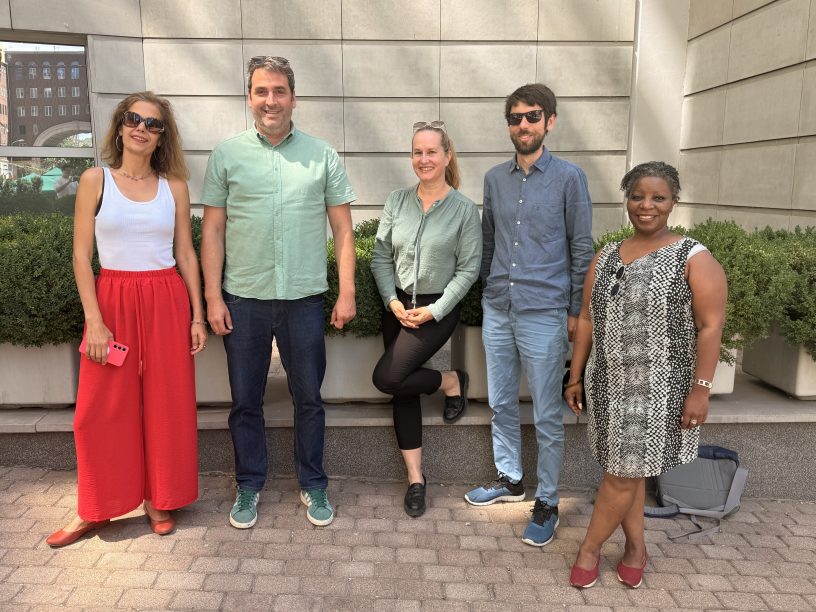


What a week it has been for the English Learning Support unit at the Centre for Learning and Innovation! Tray table folded away, seat-belt firmly in place and with a humungous city twinkling below, I was performing the Valsalva manoeuvre to relieve the aural discomfort wrought by the Airbus A320’s descent when it occurred to me that I did not know what these people called their country. Wales: Cymru, Finland: Suomi, Germany: Deutschland, but the country whose airspace we had just entered? I had no idea. “Use a lifeline or phone a friend,” I hear you say. I asked my colleague Dr André Biederbeck, the studyFIT Coordinator. He was equally clueless. But a week later, we have learnt much about Magyarország, its higher ed landscape and its deep academic traditions.
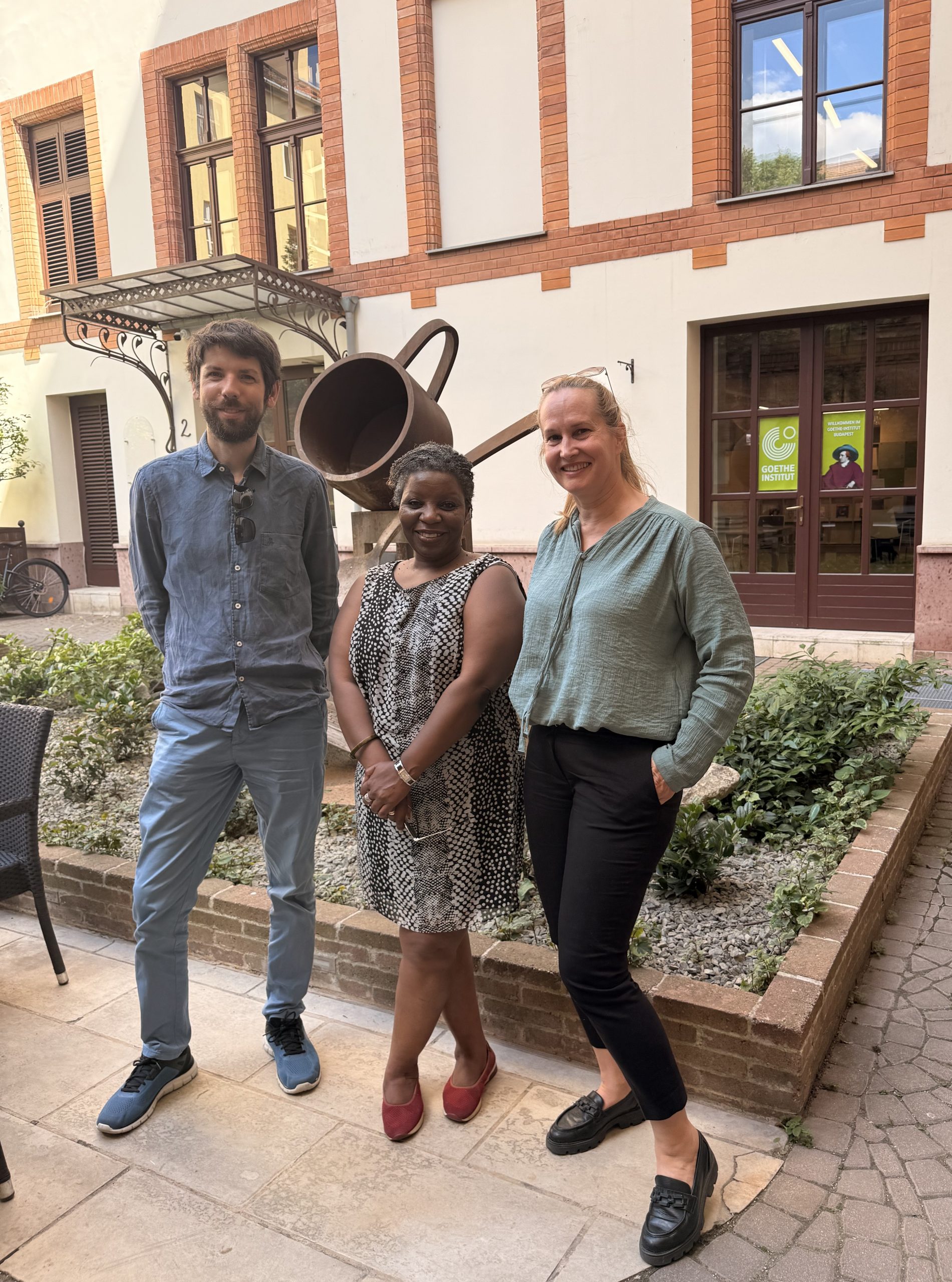
Dr André Biederbeck, Dr Prue Goredema and Emese John at the Budapest home of the Goethe Institute
Monday 8 and Tuesday 9 June were spent in the Hungarian capital, catching up with the director of the FernUniversität in Hagen’s Budapest Study Centre, Emese John alongside her team, namely Peter Benedek and Éva Tajnafői. The satellite centre has around 220 students, a reflection not so much of the long-gone Austro-Hungarian empire, but rather, the importance of German companies continent-wide. From purveyors of fast-moving consumer goods (Aldi, Lidl, Penny) to automotive manufacturers (Audi, BMW, Mercedes-Benz) many well-known brands are doing brisk business abroad. Around 80% of the centre’s students are from Budapest itself, the rest from elsewhere in Hungary. Emese John explained that the student profile is otherwise much the same as that of FernUni Hagen in general: average age 39, employed and often holding at least one degree.
And whilst FernUni has taken its teaching into a wholly digital direction (bye-bye Studienbriefe) students do still treasure having a physical place where they can attend networking events (there are at least nine workshops held there per semester). Thus, the planned September move to more spacious quarters shared with the Goethe Institute a stone’s throw from the Budapest Opera makes sense.
An excellent host, Emese John had also arranged a number of meetings for us with academics from Corvinus University of Budapest and Eötvös Loránd University who also work within a learning and innovation context.
Sharing both best practice and sob stories, we were pleased to make the acquaintance of our new Hungarian colleagues. We went on to spend a bit more time with Réka Futász and Lídia Vinczéné Fekete of Corvinus later in the week, in a different part of the country. But I digress.
A final meeting saw us at the offices of ProHuman Learning Solutions, where CEO Bertalan Péter Farkas walked us through their current projects and sparked several ideas for joint initiatives. Cross-continental collaboration is a hallmark of the projects we undertake at English Learning Support, so do watch this space for news of our next great academic adventure.
A river runs through it
Those holiday snaps you’ve been forced to admire by frenemies over the years do not do justice to the beauty of Budapest. Once two separate cities on opposite banks —toff-terrain Buda on the hillside and bustling Pest on the flatter plain — the shades of distinction are still felt. Our colleague and sometime guide, Peter Benedek of the FernUni Budapest Study Centre quipped: “There are two kinds of people in Budapest. Those who live in Buda, and those who would like to.”
There, the Danube is flanked by castles, cathedrals and colonnades and even when one ventures away from the waterfront, the fine façades go on for street after street. Some of these historic buildings stand tall because they have proudly resisted the ravages of time; others have had a post-war face lift, and others may be new but have been cleverly constructed in a style befitting of the surrounding splendour. And with the temperatures petulantly approaching 30 degrees during our sojourn there, the cafés were packed, which is to say there is no shortage of tourists in Budapest. Those of us who were there to work rather than to knock back Borsodi beers could only look on with longing. And whilst my feet and I had initially been horrified that we’d mostly be walking from meeting to meeting, it did give us the opportunity to take in some of the key sights. However, our visit to St Stephen’s Basilica prematurely ended in the narthex (that’s vestibule, for the uninitiated) – not because we are disbelieving pagans, but because we felt it is ludicrous that they charge fees for one to step into what is meant to be a place of worship. Whatever is this world coming to?
Leave a Reply